Showing posts with label Science. Show all posts
Monday, January 27, 2014
Sunday, January 26, 2014
Stephen Hawking boldly claims there are no black holes
PROFESSOR Stephen Hawking has shocked the scientific community by radically claiming there are no black holes.
In an article by Nature it is reported that Hawking, who is responsible for creating the theories on what we know about black holes today, has done away with notionsscience has held true for almost 40 years.
He claims the event horizon - an invisible boundary covering every black hole beyond which nothing, not even light can escape - do not exist.
Instead what Hawking suggests is an "apparent horizon", which temporarily traps matter and energy before releasing it into space.

Stephen Hawking has delivered theories on the universe’s most mind-bending subjects and his latest work has stirred up more thought-provoking head-scratching. Source: News Limited
"There is no escape from a black hole in classical theory," Hawking told Nature. Quantum theory, however, "enables energy and information to escape from a black hole".
Now buckle up - here's where it all gets a bit confusing.
It was previously believed that should an astronaut be unlucky enough to fall into a black hole they would happily pass through the event horizon, being gradually pulled inward - stretched out along the way like spaghetti - and eventually crushed at the black hole's infinitely dense core.
However, theoretical physicist Joseph Polchinski came to the conclusion that the laws of quantum mechanics would change the situation completely, turning it into a highly energetic area that would instead burn the astronaut to a crisp. But if this was the case it could dismiss Einstein's theory of relativity. This is what's known as the blackhole firewall paradox and it's been puzzling scientists for years.
But now Hawking's third theory as to what a black hole could look like has got physicists' heads spinning. Hawking's new suggestion is that the apparent horizon is the real boundary. "The absence of event horizons means that there are no black holes - in the sense of regimes from which light can't escape to infinity," Hawking writes.
Polchinski, however, is sceptical that black holes without an event horizon could exist in nature, "the kind of violent fluctuations needed to erase it are too rare in the Universe," he says.
If you've managed to understand any of this, we applaud you. While we won't even pretend to get our own heads around it some scientists have and explain how this revelation "highlights how abhorrent physicists find the potential existence of firewalls."
Raphael Bousso, a theoretical physicist and former student of Hawking's states: "the idea that there are no points from which you cannot escape a black hole is in some ways an even more radical and problematic suggestion than the existence of firewalls," he says. "But the fact that we're still discussing such questions 40 years after Hawking's first papers on black holes and information is testament to their enormous significance."
By:
pipspiper
On 10:36 AM
Tuesday, November 12, 2013
Need a new liver? Just print one!

A group of US scientists have created the world’s smallest human liver which can survive for forty days and works like the real thing – using a 3D printer.
The mini-livers, made by California-based medical research company Organvo, are just half a millimetre deep and four millimetres wide but can perform most of the functions that a real liver can.
The printer builds up 20 layers of hepatocytes cells, which carry out liver functions, along with two major types of liver cell. It also adds cells from the lining of a blood vessel. This allows the liver cells to receive nutrients and oxygen.
The most recent liver created survived for 40 days in the lab, which might not seem very long as human liver cells are replaced every 300 to 500 days, but the company’s previous mini-liver only survived for five days.
Keith Murphy, Organovo’s chief executive officer said: ‘In April we were able to show that liver function was retained in our 3D liver for over five days, and we have now demonstrated that our tissues perform consistently for at least 40 days, a significant improvement over the average 48 hour performance of 2D cultures.’
While research is in the early stages, scientists believe that future versions could be used for transplants. This would a significant step for more than 120,000 people worldwide on organ transplant waiting lists.
By:
pipspiper
On 10:15 AM
Monday, November 11, 2013
24,000 year old boy from Lake Baikal is 'scientific sensation'

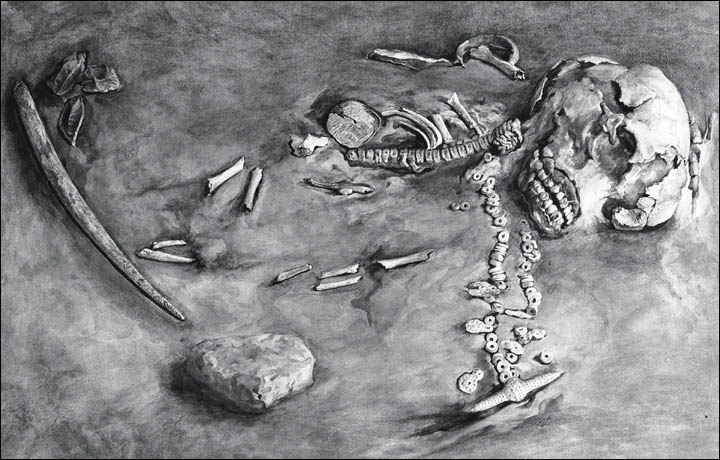
Geneticist Connie Mulligan of the University of Florida called the findings 'jaw-dropping'. DNA from this ancient Siberian skeleton offers clues to the first Americans. Picture: The State Hermitage museum, St. Petersburg
New DNA findings, if confirmed, have stunning implications for our understanding of both pre-historic Siberians - and native Americans. They would suggest that, contrary to previous understanding, some indigenous populations are - in fact - European or West Asiatic in origin.
The Danish-US research was carried out on the bones of a Siberian boy whose remains were found near the village of Mal'ta close to Lake Baikal in the 1920s in a grave adorned with flint tools, pendants, a bead necklace and a sprinkling of ochre. The remains are held in the world famous Hermitage Museum in St Petersburg and analysis of a bone in one of his arms represents 'the oldest complete genome of a modern human sequenced to date', according to Science magazine.
'His DNA shows close ties to those of today's Native Americans. Yet he apparently descended not from East Asians, but from people who had lived in Europe or western Asia,' said ancient DNA expert Eske Willerslev of the University of Copenhagen. 'The finding suggests that about a third of the ancestry of today's Native Americans can be traced to 'western Eurasia'.'
The research may help explain why 'European ancestry previously detected in modern Native Americans do not come solely from mixing with European colonists, as most scientists had assumed, but have much deeper roots', said the report.
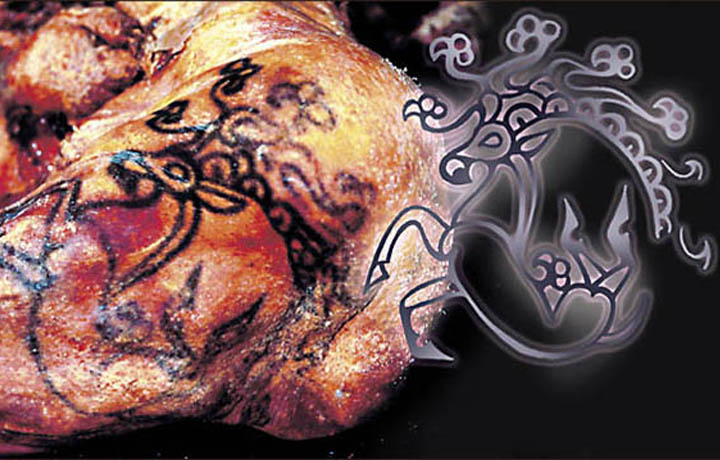
It may also raise a similar question about the 'European look' of some ancient Siberians - for example in the tattooed permafrost princess Ukok found in a burial chamber in the Altai Mountains, whose remains date from around 2,500 years ago.

'Princess' Ukok's shoulder, tattoo of fantastic animal, and a drawing of it made by Siberian scientists. Picture and drawing: Elena Shumakova, Institute of Archeology and Ethnography, Siberian Branch of Russian Academy of Science
Russian scientists reconstructed her to show what many were surprised to be a European face, unrelated to the modern day Altai tribes. The finding is confirmed by DNA analysis which showed her to be Pazyryk in origin. Her group was part of the Samoyedic family, with elements of the Iranian-Caucasian substratum'.
The four year old boy was found near the Belaya River close to the village of Mal'ta which is famed for the discovery of ancient art, some of it showing close links to European discoveries of the same period. Willerslev and co-author Kelly Graf of Texas A&M University 'used a variety of statistical methods to compare the genome with that of living populations.
'They found that a portion of the boy's genome is shared only by today's Native Americans and no other groups, showing a close relationship.
'Yet the child's Y chromosome belongs to a genetic group called Y haplogroup R, and its mitochondrial DNA to a haplogroup U. Today, those haplogroups are found almost exclusively in people living in Europe and regions of Asia west of the Altai Mountains, which are near the borders of Russia, China, and Mongolia.'
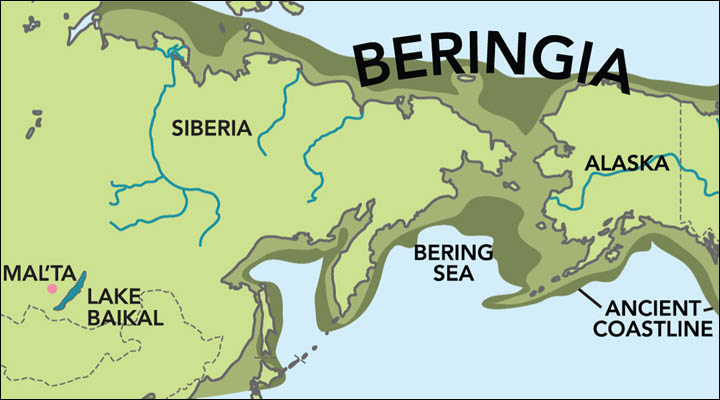
Until now it has been widely believed that Native Americans were linked to Eastern Siberian tribes, having crossed Beringia, a vast Ice Age land bridge.
The magazine report stated: 'One expected relationship was missing from the picture - the boy's genome showed no connection to modern East Asians.
'DNA studies of living people strongly suggest that East Asians - perhaps Siberians, Chinese, or Japanese - make up the major part of Native American ancestors. So how could the boy be related to living Native Americans, but not to East Asians?'

The Mal'ta boy was related to people who later migrated across Beringia to the Americas. Picture: G.Grullon/Science
Willerslev and his team propose that earlier than 24,000 years ago 'the ancestors of Native Americans and the ancestors of today's East Asians split into distinct groups.
'The Mal'ta child represents a population of Native American ancestors who moved into Siberia, probably from Europe or west Asia. Then, sometime after the Mal'ta boy died, this population mixed with East Asians. The new, admixed population eventually made its way to the Americas.'
The timing is uncertain but 'the deep roots in Europe or west Asia could help explain features of some Paleoamerican skeletons and of Native American DNA today'. Some of the traces of Eurasian genetic signatures in modern Native Americans do not come from colonial times when incoming Europeans mixed with the indigenous population.
'Some of them are ancient,' said Willerslev. Geneticist Connie Mulligan of the University of Florida called the findings 'jaw-dropping'.
Yet perhaps the findings - the full details of which are due to be published soon in Nature journal - are not so surprising. Famed Russian archeologist Mikhail Gerasimov found art work at Mal'ta which show a close resemblance to European female figurines of the Upper Paleolithic period. The similarities extend to tools and dwelling structures.
By:
pipspiper
On 3:13 PM
39,000 year old brain starts to give up its secrets

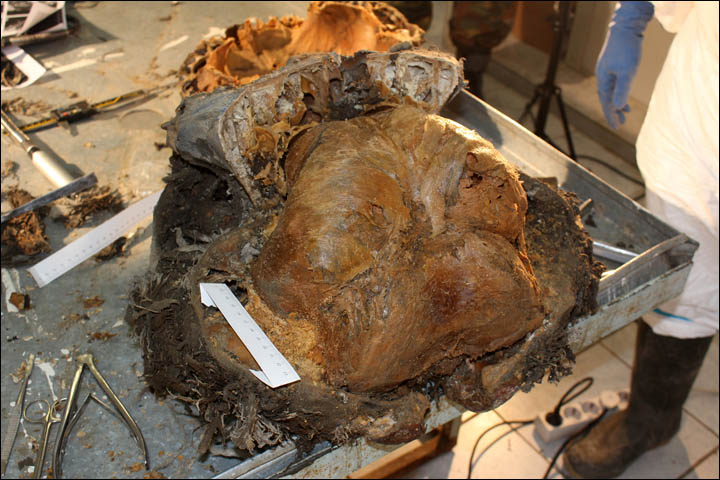
Crucially 'scientists have identified the main functional areas of the brain, making it possible to talk about creating a brain atlas'. Picture: Sakha Republic Academy of Science
By Anna Liesowska
08 November 2013
Scientists get inside a woolly mammoth's head to understand behaviour of the extinct species.
The superbly-preserved remains of Yuka were found in 2009 in the Siberian permafrost, but only recently have specialists begun to analyse her brain in a unique study.
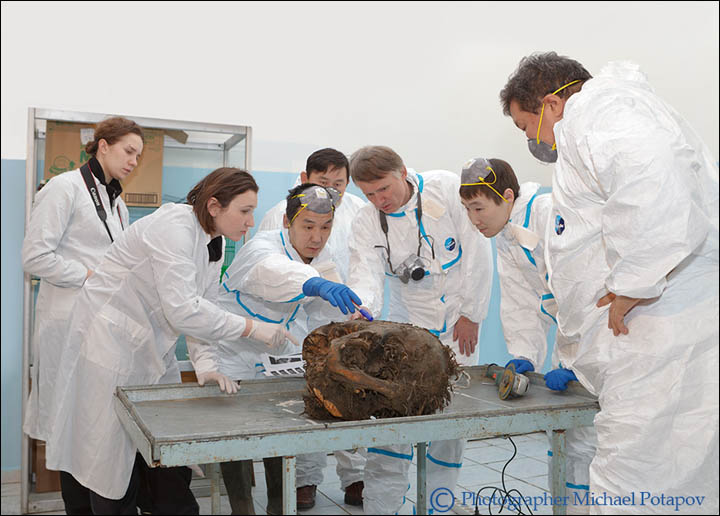
Scientists disclosed that the remains are in such good conditions that a full-scale brain mapping exercise is underway which is expected to significantly boost our understanding of the woolly mammoth, a creature which scientists are separately planning to bring back to life using modern technology.
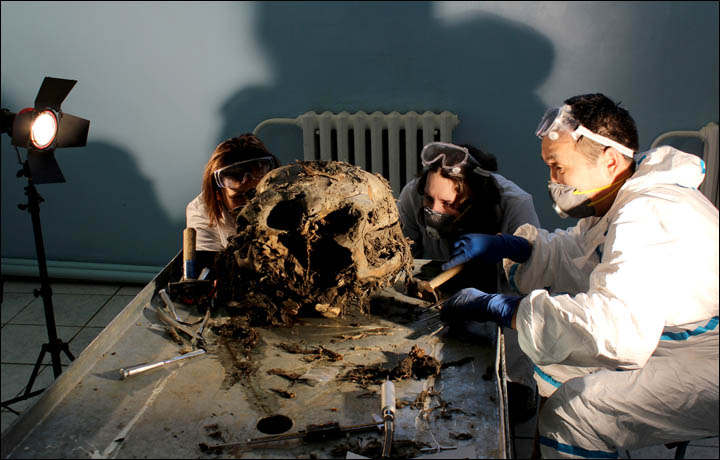
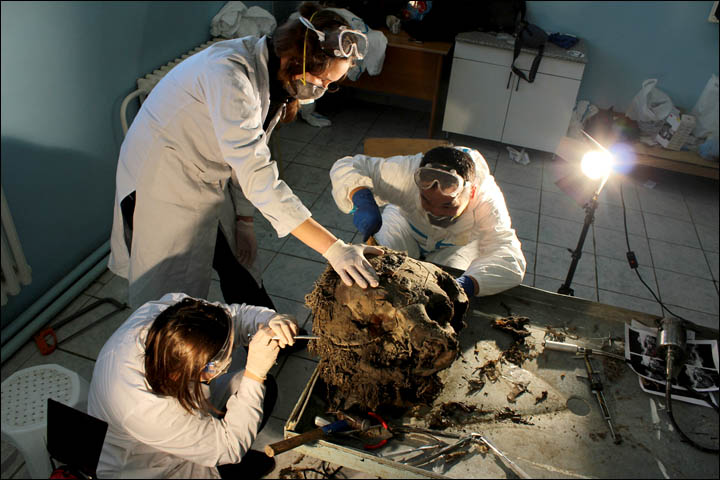
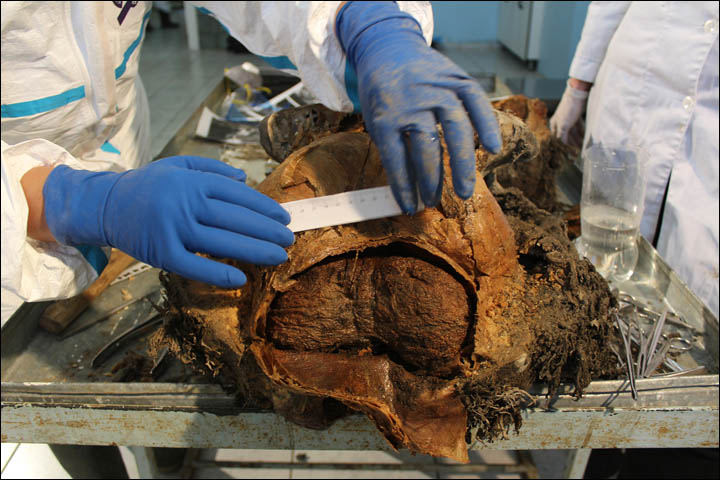
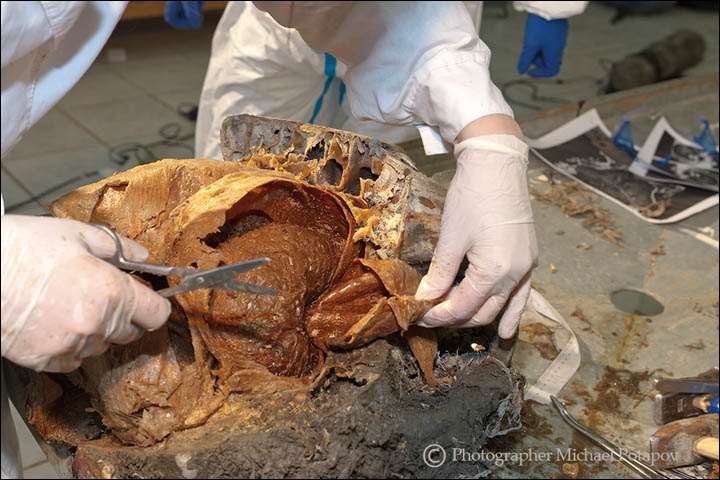
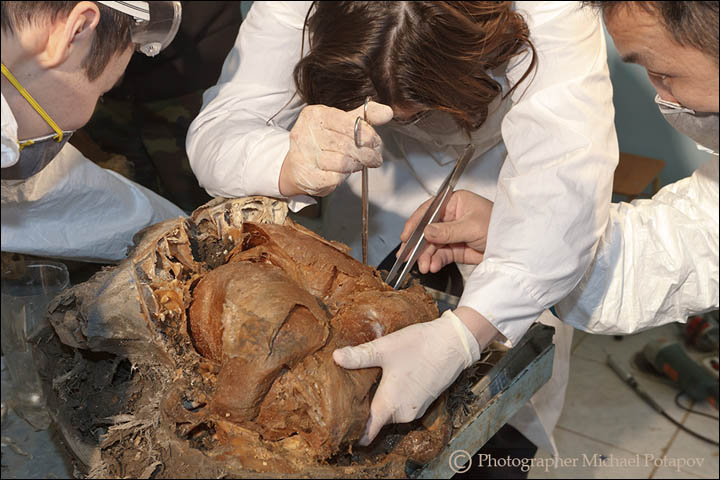
Our remarkable pictures show the historic moment the brain was removed from Yuka's remains before the analysis began. The initial findings were presented at the 73rd Symposium of the Society of Vertebrate Paleontology in Los Angeles.


The first in the world wolly mammoth's brain autopsy. Pictures: Sakha Republic Academy of Science
These revealed the breakthrough that came when the first CT scan of the cranium was performed at the Republic of Sakha Academy of Sciences, Yakutsk in May 2012 to understand the morphology of Yuka's molars.
'It unexpectedly revealed the preserved brain with well-defined major gross anatomy features, including frontal, temporal, and parietal lobes with gyri, and cerebellum with internal structures, which yielded the first chance to examine woolly mammoth brain morphology,' said the Yakutsk team. 'The brain extraction was performed based on our own experience combined with the generally used treatment for large mammals, including modern elephants.
'In February 2013, the brain was preserved by the method of flowing fixation developed by Professor Sergei Saveliev (Research Institute of Human Morphology, Russian Academy of Medical Sciences (RIHM, RAMS) in Moscow), which included three weeks of continuous preservation of the braincase content only using formalin.'
'The skull trepanation was performed on 25 February in Yakutsk' - and is shown in our pictures.
'After the extraction, the brain was wrapped with fabric for support and placed into formalin solution overnight before being flown to Moscow. It is currently stored in formalin solution at the Research Institute of Human Morphology'.

Scientists disclosed that the remains are in such good conditions that a full-scale brain mapping exercise is underway which is expected to significantly boost our understanding of the woolly mammoth. Picture: Michael Potapov, Sakha Republic Academy of Science
Initial results of research confirm 'similar morphology to the brain of modern elephants', but much deeper study is needed, they say. The brain was dehydrated because of the mummification process, there was some shrinkage. Oxidation processes in the brain stained it brown.
Crucially 'scientists have identified the main functional areas of the brain, making it possible to talk about creating a brain atlas,' said a report by Professor Albert Protopopov and colleagues. This will proceed in Moscow, he said, at the Institute of Human Morphology under the guidance of Professor Saveliev.
'This discovery holds great scientific significance. This is the first time scientists have got their hands on the brain of an animal that lived tens of thousands of years ago, and one that is in such good condition,' said Professor Protopopov. The woolly mammoth brain research will help academics 'to understand particular aspects of their behaviour'.


Wolly mammoth's brain autopsy. Pictures: Michael Potapov, Sakha Republic Academy of Science
Other mammoth discoveries did not have intact brains due to 'dehydration or rotting. Many skulls were found damaged'. Yuka was around ten years old when she died. The mammoth's brain was not the largest among land animals, he said.
'Dinosaurs were still larger,' Protopopov said, as were Colombian mammoths in North America. 'Our woolly mammoths were smaller.'
Another scientist Gennady Boeskorov confirmed to the symposium that Yuka's remains - despite being so life-like - do not contain any living cells.
'Initially, we need a living cell for the scientific process organisation, but unfortunately, the corpse of Yuka does not contain any,' he said. 'Now, scientists from around the world are working to decipher the DNA of a mammoth. If it is successfully completed, the next step will be re-creation of its similarity and implantation of its nucleus into an elephant cell. Theoretically, it is possible, but practically, no one in the world has been able to carry out such an experiment, which will take a lot of time'.
Still, as Yuka's brains are examined to unlock the secrets of time, her carcass is delighting hoards of museum-goers, as she continues a tour of the modern world in a chilled display cabinet. This weekend she goes on show in Taiwan after a highly successful visit to Japan.
By:
pipspiper
On 1:53 PM
Subscribe to:
Posts (Atom)